Read in English below
C’est le mois de mai, le joli mois de mai comme le dit la chanson et le mois de mai est un mois formidable en France. C’est celui des jours fériés, du pont de l’Ascension et du muguet.
Le 1er mai en France, on fête le travail et du coup c’est un jour férié. Ce jour-là, il y a une tradition très française qui est celle d’offrir un brin de muguet à ses proches ou à ses amis.
Chaque année près de 70000 millions de brins de muguet sont vendus partout en France dans les magasins, chez les fleuristes et aussi au coin des rues. Pour ceux qui aiment les gros chiffres, il s’agit d’un marché d’environ 25 millions d’euros. Autant dire que les Français adorent le muguet !

Cette tradition se perd dans les méandres de l’Histoire et il n’est pas évident d’en retrouver l’origine. Elle commencerait avec les Grecs de l’Antiquité. Apollon couvrait le sol de muguet pour que ses muses ne se blessent pas les pieds. Pour les traditions nordiques, le muguet symboliserait le retour du printemps et pour les chrétiens, les larmes que la Vierge Marie aurait versées au pied de la croix. Chaque tradition apporte un éclairage intéressant sur l’état d’esprit de nos cultures : artistique, pragmatique ou dramatique.
Dans l’histoire de la France, le muguet était invité à la cour des rois, mais il fit aussi la Révolution. Il était offert pour le « jour républicain » le 26 avril. Le 1er mai était alors le jour de l’églantine rouge qui fut l’emblème des révolutionnaires et des travailleurs jusqu’au 19e siècle. Au 20e siècle, le muguet fait son show et accompagne sur scène le chanteur Félix Mayol qui l’accroche au revers de sa veste comme porte-bonheur. Félix Mayol est l’irrésistible créateur de la fameuse chanson – fameuse en France du moins- « Viens Poupoule ». Une chanson élégante et poétique comme la France. Oui, je suis un peu sarcastique.
C’est pendant la Seconde Guerre mondiale que le muguet est devenu la fleur du 1er mai. En 1941, le maréchal Pétain, le grand collaborateur de la France nazie, a décrété que le muguet serait la fleur de la fête du Travail et de la concorde sociale. Dans un de ces paradoxes de l’Histoire dont la France est très friande, le muguet est aujourd’hui associé au Parti communiste français
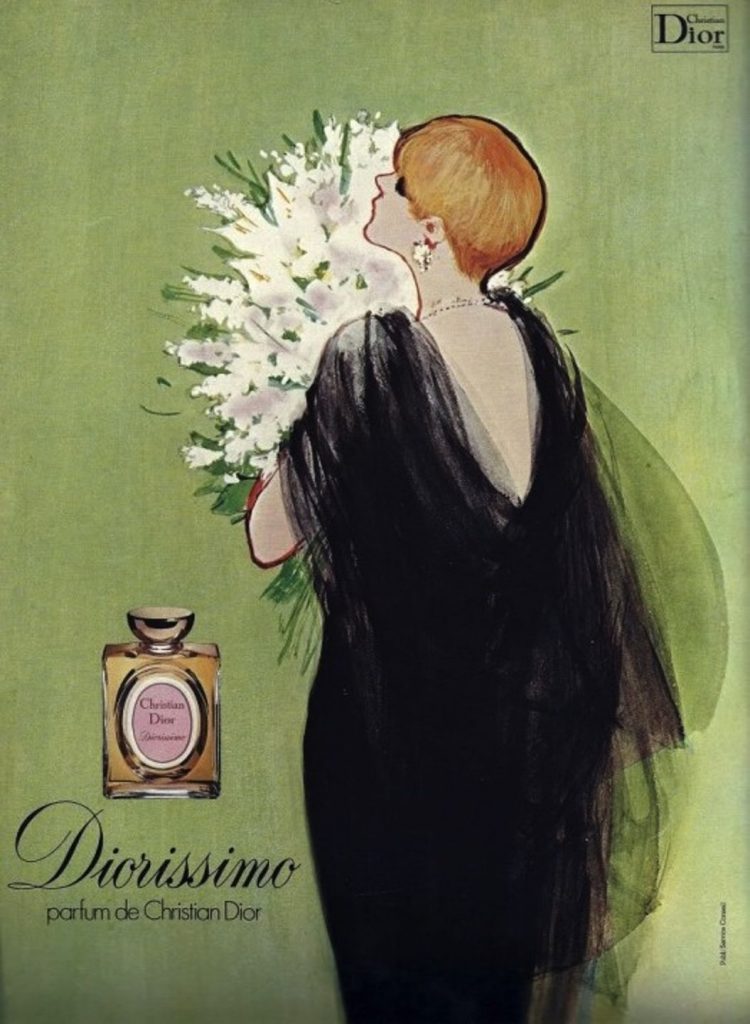
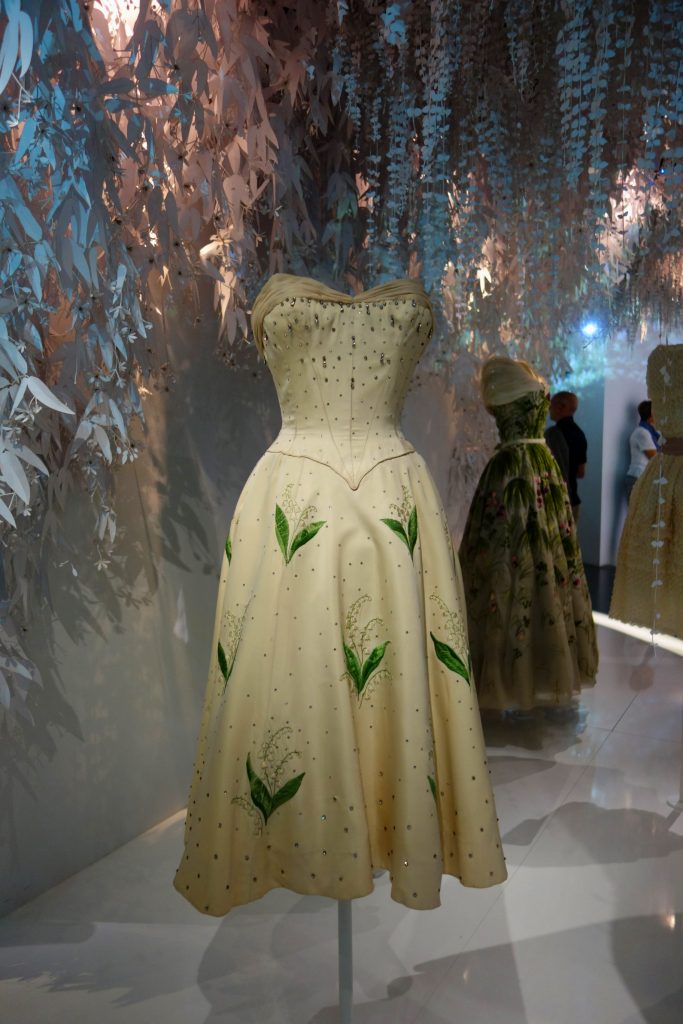
Le muguet a toujours été à la mode. Il a même été l’égérie de Christian Dior qui lui avait créé une robe simplement appelée « Muguet ». Christian Dior était superstitieux et en cousait toujours un brin dans l’ourlet de ses créations avant les défilés pour lui porter chance. Il l’aimait tellement qu’il en a fait le symbole de sa maison de couture. La maison Dior continue cet hommage à cette petite fleur toute simple en lui dédiant notamment sa collection Dior Maison 2020.
Plus modestement, le muguet est ma fleur préférée. Mes parents m’en offraient toujours le jour de mon anniversaire et mon père en avait tout un parterre dans son jardin. C’était mon porte-bonheur. Depuis que je vis aux USA, je n’ai plus mon brin de muguet le jour de mon anniversaire. J’ai essayé d’en planter, mais le cœur n’y était pas et il n’a pas poussé. Depuis quelques années, mon père n’est plus là et ma mère a quitté la maison et le jardin. Le muguet est devenu mon petit brin de nostalgie. C’était la fleur de mon enfance et celle de mes jolis souvenirs. Le temps passe, les souvenirs s’estompent, mais le cœur n’oublie pas dit-on.
En Anglais, le muguet se dit Lily of The Valley. C’est un nom qui raconte une histoire. Celle d’un petit brin devenu grand, mais qui n’oublie pas d’où il vient. J’aime ce nom et sa poésie charmante. En écrivant ces mots, je réalise l’avantage que j’ai de vivre entre deux cultures. Je peux choisir le meilleur de chacune. Je prends le brin de muguet pour la France et son nom pour l’Amérique.
Le printemps n’est pas le temps de la nostalgie, mais celui de l’espoir et du renouveau. Pour terminer ce post avec une note légère, mais pas fine, voici pour les amoureux de la chanson française « Poète-Poète » « Viens Poupoule » par Félix Mayol.
Heureux polissons!
FEG
In English Please!
It’s May, the lovely month of May as the song goes, and May is a great month in France. May has holidays, a four-day weekend for the Ascension, and the lily of the valley.
In France, on May 1, we celebrate labor, so it’s a public holiday. On this day, there is a very French tradition to offer a sprig of lily of the valley to relatives or friends.
Every year, nearly 70,000 million sprigs of lily of the valley are sold all over France in stores, florists, and also on street corners. For those who like big numbers, this is a market of around 25 million euros. That is to say that the French love lily of the valley!

This tradition is lost in the twists and turns of history, and it is not easy to find its origin. It would start with the ancient Greeks. Apollo covered the ground with the lily of the valley so that his muses did not hurt their feet. For Nordic traditions, the lily of the valley symbolizes the return of spring and, for Christians, the tears that the Virgin Mary would have shed at the foot of the cross. Each tradition sheds exciting light on the state of mind of our cultures: artistic, pragmatic, or dramatic.
In the history of France, the lily of the valley was invited to the court of kings. It also made the Revolution and was offered for “Republican day” on April 26. May 1 was then the day of the red eglantine, the emblem of revolutionaries and workers until the 19th century. In the 20th century, the lily of the valley made its show and accompanied the singer Félix Mayol on stage, who hitch it on the lapel of his jacket as a lucky charm. Félix Mayol is the irresistible creator of the famous song – famous in France at least – “Viens Poupoule.” An elegant and poetic piece like France. Yes, I am a little sarcastic.
It was during World War II that the lily of the valley became the May Day flower. In 1941, Marshal Pétain, the great collaborator of Nazi France, decreed that the lily of the valley would be the flower of Labor Day and Social Harmony. In one of those historical paradoxes that France is very fond of, the lily of the valley is now associated with the French Communist Party.
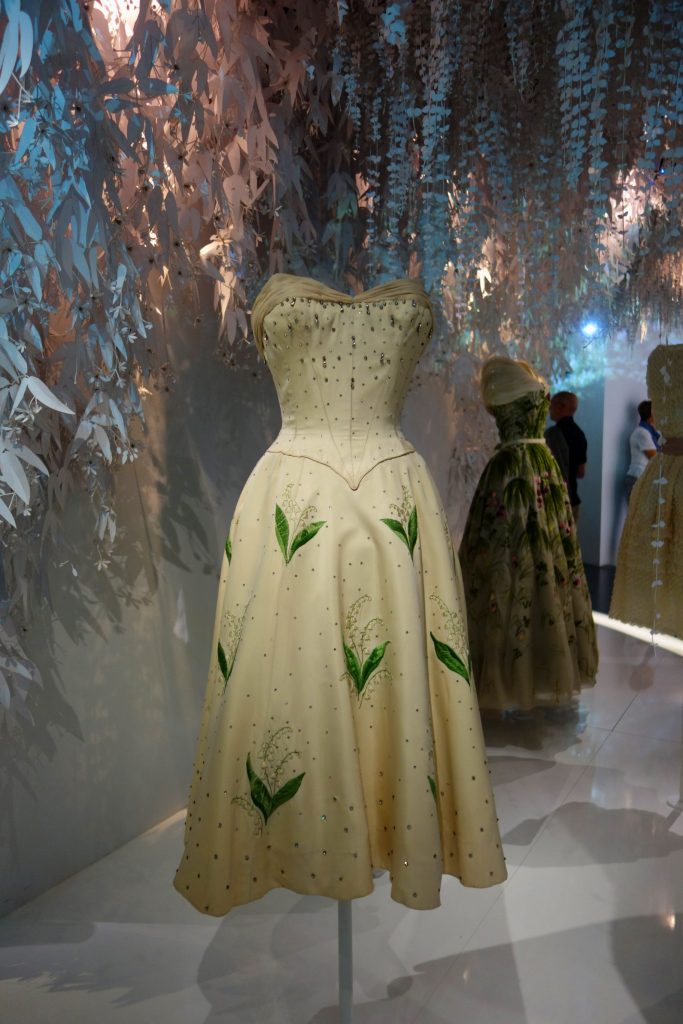
The lily of the valley has always been in fashion. It was even the muse of Christian Dior, who had created a dress called “Muguet.” Christian Dior was superstitious and always sewed a sprig of it into the hem of his creations before the shows to bring him luck. He loved it so much that he made it the symbol of his fashion house. The Dior house continues this tribute to this lovely little flower by dedicating its Dior Maison 2020 collection to it in particular.
More modestly, the lily of the valley is my favorite flower. My parents always gave me some on my birthday, and my dad had a whole flower bed in his garden. It was my lucky charm. Since living in the USA, I no longer have my lily of the valley on my birthday. I tried to plant some, but the heart wasn’t there, and it didn’t grow. For a few years now, my father is not with us anymore. My mother has left the house and the garden. Now, the lily of the valley has become my little sprig of nostalgia. It was the flower of my childhood and my fond memories. Time passes, memories fade, but the heart doesn’t forget, they say.
In English, “Le muguet” is called Lily of the Valley. It’s a name that tells a story. That of a sprig that has grown up, but that does not forget where it came from. I love this name and its charming poetry. As I write these words, I realize the advantage I have of living between two cultures. I can choose the best of each. I take the lily of the valley for France and its name for America.
Spring is not the time for nostalgia but the time for hope and renewal. To end this post with a light note, but not a very refine one, here is for lovers of the French songs and the French “Poète-Poète” (which I can try to explain as a game with the word poet to make the sound peep peep)
Here is “Viens Poupoule” by Félix Mayol.
Enjoy little rascals!
Florence de Pont


 Florence de Pont
Leave a reply to perpibibi Cancel reply